From time to time, I am asked whether it is appropriate for a funeral celebrant to include religious prayers in a service.
It is a fair question.
The situation often arises when a family chooses a funeral home, crematorium or non-religious venue but still wishes to include a familiar prayer such as The Lord’s Prayer or a Hail Mary. Sometimes they are recreating elements of a previous funeral held in a church. Sometimes they simply find comfort in words they have known all their lives.
As a funeral celebrant in Oxfordshire, I believe this conversation deserves clarity rather than tension.
Who Does a Funeral Service Belong To?
The starting point is simple.
A funeral service belongs to the family and to the person being honoured. It does not belong to the celebrant or to a priest. Additionally, it does not belong to a template of what is expected.
Families are navigating grief. They are choosing music, readings and words that bring comfort. If a prayer offers that comfort, it deserves thoughtful consideration. Prayers such as The Lord’s Prayer do not belong to one institution. People have spoken them across generations and denominations. They are widely known pieces of liturgy that have been spoken across generations and denominations. They are part of cultural and spiritual heritage. Including a prayer in a funeral service does not mean a celebrant is pretending to be ordained. It means they are facilitating the wishes of the family.
There is a clear difference.
The Difference Between Leading and Imitating
A funeral celebrant is not a priest. That distinction matters.
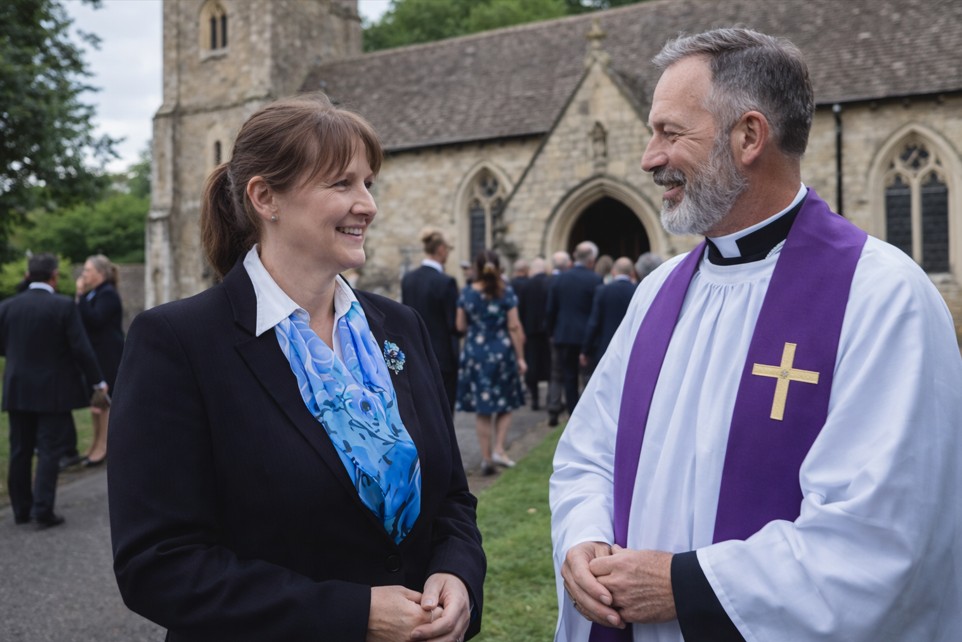
When I lead a service, I do so as an independent funeral celebrant in Oxfordshire, and I am transparent about my role. My style of clothing alters to the wishes of the family, and I don’t wear clerical dress. I do not present myself as ordained. I do not conduct sacraments.
But if a family wishes to include The Lord’s Prayer within a crematorium service, I will read it respectfully or invite the congregation to join. That is not imitation. It is inclusion. The key is intention and clarity.
If a service is being held within a church under the authority of a priest, that is different. The structure and leadership are defined. But in a funeral home or crematorium, families often seek flexibility. They may want a non-religious funeral service that still acknowledges elements of faith. We can achieve that balance respectfully.
Why Families Request Familiar Prayers
There are several reasons families ask for prayers in a service outside of a church.
- Tradition. If previous generations had church funerals, repeating certain readings feels like continuity.
- Comfort. Familiar words can steady people when everything else feels unstable.
- Inclusion. In many congregations there will be a mixture of beliefs. Some will take comfort in prayer. Others may remain silent. Including a short prayer can allow everyone to take part in the service in their own way.
When writing a funeral service, these details matter to me and, more importantly, to the family I am looking after. The role of the celebrant is to reflect the person and their community, not impose personal preference.
Professional Boundaries Matter
While I believe families have the right to include prayers, professionalism must always guide the decision.
As a funeral celebrant in Oxfordshire, I consider:
- The venue
- The expectations set with the funeral director
- Whether clergy are involved
- The clarity of my role
- The wishes of the family
If a priest is officiating, I would never insert myself into their authority, and if I am leading the service, I remain clear that I am doing so as a celebrant, not as ordained clergy.
Language matters. Presentation matters. Respect matters. The goal is not to win a theological debate. The goal is to honour the person who has died.
Collaboration with Funeral Directors
Funeral directors play an important role in these situations. They often understand local expectations and sensitivities. The relationship between a funeral celebrant and a funeral director is paramount. Clear communication avoids confusion. I note any religious elements clearly in the order of service and agree them in advance with the funeral director and family. Surprises on the day serve no one. Professional preparation protects everyone involved.
A Non Religious Service Does Not Mean Anti Religious
There is sometimes an assumption that a nonreligious funeral service must exclude all references to faith. In practice, many families sit somewhere in the middle. They may not attend church regularly. They may not want a fully religious ceremony. But they may still value a prayer spoken at significant moments in life.
As an independent funeral celebrant, my role is to create a personal funeral service that reflects the individual honestly.
That might mean:
- A hymn from childhood
- A reading from scripture
- The Lord’s Prayer spoken together
- Or a completely secular ceremony
There is no single correct format. There is only what feels right for that family.
Respecting Different Perspectives
It is important to acknowledge that some clergy may feel protective of certain liturgical elements. That perspective deserves respect too. But protection should not become ownership. Faith traditions are shared across communities. They belong to believers, not exclusively to institutions.
Including a prayer in a crematorium service, when done with integrity, does not diminish its meaning. It extends into the lives of people who may not otherwise step into a church. Tone makes the difference. Delivery makes the difference.
Writing a Funeral Service with Care
Ultimately, the debate about prayers sits within a much bigger responsibility. Writing a funeral service takes time. It takes listening, structuring and shaping words that represent a life accurately. A single prayer does not define the service. It sits within a carefully prepared narrative.
As a funeral celebrant in Oxfordshire, I often spend close to twenty hours preparing a personal funeral service. That preparation ensures that any religious elements included feel natural rather than inserted. It ensures the service flows calmly within chapel time constraints. It ensures the tone remains respectful.
The Service Belongs to the Family
If there is one principle I return to consistently, it is this: The service belongs to the family.
It is the family honouring their loved one, the deceased. The family is at the beginning of their grieving process. They know the congregation and will understand which elements will bring comfort.
My role is to guide them, advise them, and ensure the final service feels cohesive and steady. I do not claim territory and I have no desire to compete with any faith. My role is not to defend institutions. My role is to support the family. I work quietly in the background, shaping the service so that the focus remains where it belongs. Most people will never know the hours of preparation behind the words. That is exactly as it should be. It is the words that are being said. I understand my position in the service, most people won’t ever know my name or the work I have put into the service, which is how it should be, I am there to support the family and help them to start the healing process.
Final Thoughts
Including a Hail Mary or The Lord’s Prayer in a funeral home service, at a crematorium or at a location of the family’s choice, is not about pretending to be ordained. It is about responding to the wishes of a grieving family with professionalism and care.
Absolutely, boundaries matter. Clarity matters. Respect matters. When those principles are upheld, there is space for tradition, comfort, and dignity to coexist.
If you are arranging a funeral and are unsure about including religious elements, I am always happy to discuss your options openly and honestly. As a funeral celebrant in Oxfordshire, my focus remains the same. To create a personal funeral service that honours the person who has died and supports the people who remain.